When Should We Stand Up While Iqamat Is Being Recited In A Congregational Prayer?
When should we stand up while iqamat is being recited in a congregational prayer?
The issue of when the congregation should stand up for prayer is not related to the essence of prayer but to its customs and mustahabs.
According to Imam al-A’zam, it is an etiquette of the prayer that the imam start the prayer just when “qad qamat as-salat”, which means “prayer has started”, is said in the iqamat. Thus, the imam confirms the word of muazzin. According to this ijtihad, both the imam and the congregation need to form the rows before recitation of this sentence (al-Fatawa al-Hindiyyah, I, 64). However, it is also permissible to start prayer after completion of the iqamat. Besides, according to Imam Abu Yusuf and many other mujtahids, this is the appropriate practice (Aliyy al-qari, Fath Bab al-‘Inayah, I, 211; Ibn Abidin, Radd al-Muhtar, II, 177; Mehmed Zihni, Ni‘met al-Islam, p. 304).
According to another opinion in the Hanafi school, the imam and congregation stand up when muazzin recites the sentence of “hayya ala’l-falah”, which means “come to salvation” (Ibn Nujaym, al-Bahr, I, 270), the imam starts the prayer and the congregation follows him.
According to the Shafi’i school, it is mustahab to stand up for prayer after iqamat is finished (Nawavi, al-Majmu’, III, 252-253). The congregation should not stand up for prayer before the imam stands up or arrives.
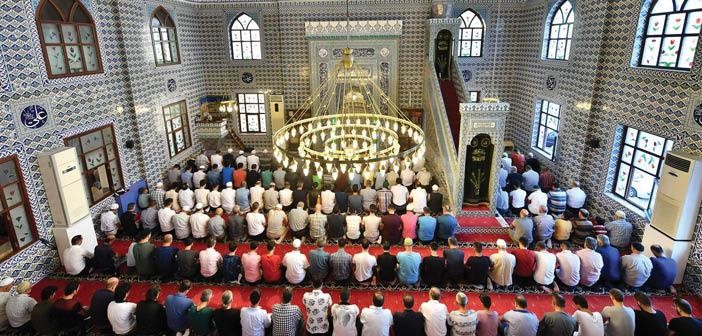
As the issue of when to stand up for prayer while iqamat is being recited is not related to the essence of prayer but to its customs, the size of mosque, forming rows, and starting prayer with imam need to be taken into consideration. It will be better in normal-size mosques or masjids to stand up after seeing that imam walks towards mihrab. Because the Messenger of Allah (saw) said, “When iqamat is recited for prayer, do not stand up until you see me.” (Bukhari, Adhan, 22) According to this, congregation should stand up before a period that is not too late to follow the imam and is enough to start prayer with him (See. Zuhayli, al-Fiqh al-Islami, I, 560).
Source: Presidency Of Religious Affairs The Turkey, High Board of Religious Affairs FATWAS